
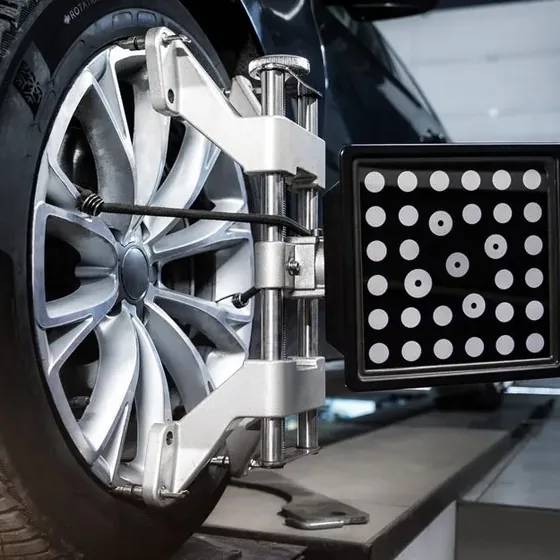
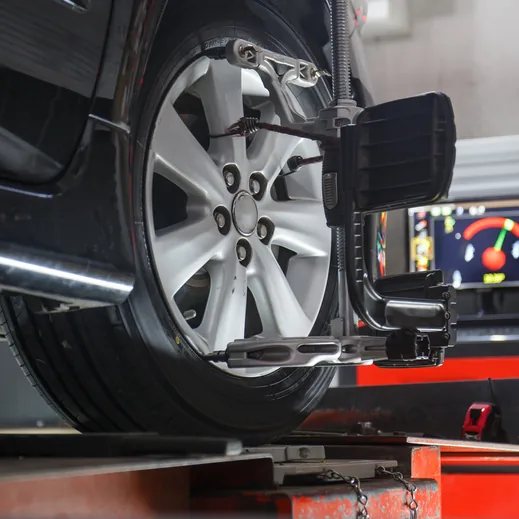
On-site alignment machine
Wheel
alignments
Pulling to one side, a steering wheel that sits crooked on a straight road, or tires wearing out on one edge. We align on our own machine here, and you get a printout of the numbers before and after — not just an assurance that we did it.
- Equipment
- Our own alignment machine, on site
- You get
- A before and after printout
- Book it after
- New tires, suspension work, or a big pothole
Why it’s worth doing
Edmonton roads
are hard on
alignment.
Freeze, thaw, repeat. A winter here does things to pavement that a set of control arms was not designed to absorb, and one solid pothole is enough to knock a wheel out of specification. You don’t always feel it happen — the first sign is often a tire wearing out on one shoulder months later.
That’s the real cost. A misaligned vehicle scrubs tread off at an angle for every kilometre you drive, and a set of tires ruined early costs several times what the alignment would have. It also drags fuel economy down and makes the steering feel vague or busy on the highway.
An alignment sets the angles the wheels sit at — toe, camber and caster — back to what the manufacturer specified for your vehicle. It’s measurement work, which is why the printout matters: you can see what was out and what it is now.
a tie rod
shoulder wear
Signs you need one
Any one of these is worth a check. Two or more and it’s costing you tires.
- It pulls to one side when you let go on a level road
- The steering wheel sits crooked while you’re driving straight
- Uneven tire wear — one shoulder gone, the rest fine
- The steering feels vague or wanders at highway speed
- You just hit something — a pothole, a curb, a snow-buried obstacle
- You just bought new tires and want them to last
- Suspension or steering work was recently done
- After a collision repair, before you call the job finished
How we do it
Including the part some shops skip — checking whether the vehicle can hold an alignment before charging you for one.
Inspect first
Tie rods, ball joints, bushings, wheel bearings and tire condition. A worn joint means the vehicle won’t hold an alignment — so we check before, not after.
Measure
Onto the machine, heads on the wheels, and we read the current angles against the manufacturer’s specification for your vehicle. That’s the “before” sheet.
Adjust
Toe, camber and caster brought back into specification where the vehicle allows adjustment — and we tell you if it doesn’t, and what that would take.
Verify and road test
Final numbers printed, steering wheel centred, and a road test to confirm it tracks straight and the wheel sits where it should.
Alignment questions
How often should I get an alignment?
There’s no fixed interval — it depends on what your vehicle has been through. A reasonable habit is once a year, or whenever you put new tires on, plus any time you hit something hard enough to make you wince. If the vehicle drives straight and the tires are wearing evenly, it doesn’t need one.
How long does it take?
Usually about an hour for a straightforward four-wheel alignment. It takes longer if adjustment hardware is seized — common on older vehicles that have spent their lives on salted roads — or if we find worn components that need replacing before an alignment will hold.
Will an alignment fix my vibration?
Probably not. A vibration at speed is usually a balance problem, a bent wheel, or a tire with a belt shifting inside it. Alignment fixes pulling, crooked steering wheels and uneven wear. They’re different problems, and we’ll tell you which one you have rather than selling you the wrong service.
Do I need a four-wheel alignment or just the front?
Most modern vehicles benefit from a four-wheel alignment, because the rear angles affect how the vehicle tracks and where the steering wheel ends up sitting. On some older solid-axle vehicles, a front alignment is all there is to adjust. We’ll tell you which applies to yours.
My vehicle still pulls after an alignment somewhere else.
Bring it in with the printout if you have one. A pull that survives an alignment is often a tire issue — a radial pull from the tire construction itself — or a dragging brake, or a worn component that lets the angle change under load. Those are all findable, and the printout tells us what was set and whether it held.
Do I need an alignment after new tires?
You don’t strictly need one, but it’s the cheapest insurance available on a purchase that size. If the alignment was already out, the new tires start wearing wrong from the first drive. Doing both at once means the set lasts as long as it should.
Related services
Pulling, crooked, or eating tires?
Book it in. You’ll leave with a printout showing what was out and what it is now.