

Our specialty
Auto electrical
diagnosis & repair
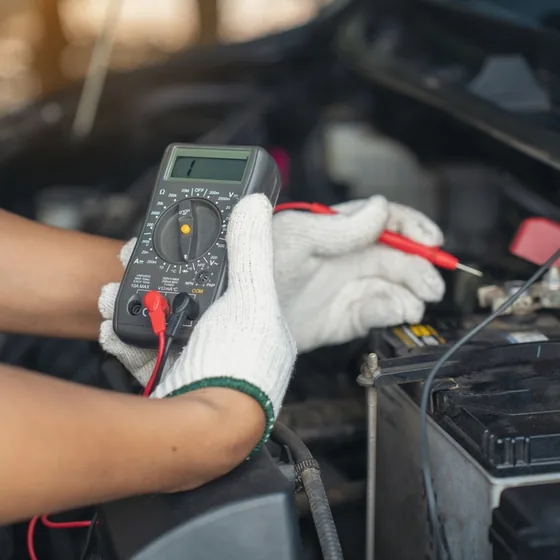
If you’ve been told “we don’t do electrical” more than once, you’ve found the right shop. We chase the fault through the circuit with wiring diagrams and meters until we know what’s actually wrong — then fix that.
Why shops say no
Electrical faults
can’t be quoted
off a parts list.
A water pump is a known part and a known labour time. Any shop will happily book that. But “the battery is dead every Monday” could be a glovebox light, a failed module that never goes to sleep, a chafed wire behind the kick panel, or an accessory someone wired straight to the battery two owners ago.
What we fix
If it involves a wire, a connector, a ground or a module, it’s ours.
Power, charging and starting
- Parasitic draws — the battery that drains overnight or over a weekend
- No-start and crank-no-start diagnosis
- Alternators, starters and charging faults — including “I already replaced the battery twice”
- Battery cables, terminals and ground straps
Wiring, modules and electronics
- Harness and connector repair — chafing, corrosion, rodent damage
- Module and CAN network faults — communication errors, modules that won’t sleep
- Lighting — headlights, tails, signals, interior and trailer wiring
- Power accessories — windows, locks, mirrors, seats, sunroofs
- Sensors and switches that read wrong or drop out
- Aftermarket install clean-up — remote starters, stereos, lights, someone’s fuse-tap special
Electrical questions
How long does electrical diagnosis take?
It depends entirely on the fault. A draw that shows up on the first pull of a fuse might take under an hour. One that only appears after the vehicle has been asleep for six hours takes longer, because we have to wait for it. We’ll give you a realistic estimate of diagnostic time before we begin, and we check in with you rather than quietly running the clock.
Why do I pay for diagnosis separately from the repair?
Because on electrical work, finding the fault is the job. The repair afterwards is often a connector or a length of wire. Charging for the time it takes to locate it is what lets us take on work that needs real diagnostic time — and it’s more honest than padding a parts bill to cover it.
My battery keeps dying but the battery tests fine. What now?
That’s the classic parasitic draw. Something in the vehicle is drawing current after everything should have powered down — a module that never goes to sleep, a stuck relay, a lamp in a compartment you never open, or an aftermarket accessory. We measure the draw, then isolate it circuit by circuit until the number drops.
Can you fix a wiring harness, or does it need replacing?
Most of the time we repair it. A full harness is expensive and often not available for older vehicles. Damaged sections get properly repaired — correct gauge wire, soldered or crimped to spec, sealed and supported — which on a rodent-damage job is a fraction of the cost of replacement.
Do you work on hybrids and EVs?
Call us with your year, make and model before booking. We handle low-voltage electrical faults on a wide range of vehicles, but high-voltage battery and drive systems vary a great deal by manufacturer — we’ll tell you straight whether your vehicle is one we can help with.
Another shop already replaced parts and it didn’t help. Is that a problem?
No, but tell us exactly what was replaced and when. It saves us testing things that are already new, and sometimes the previous work is itself the clue — a connector disturbed during a repair is a common cause of the fault that appeared right after it.
Related services
Chasing an electrical fault?
Tell us what it’s doing and when. We’ll tell you what’s involved in finding it before you commit to anything.